Run your thumb across the chest of any decorated tee and you can usually tell how the design got there. A screen print feels like a thin skin of ink, or like nothing at all. Embroidery is raised and you can count the stitches. A heat transfer has an edge you can catch with a fingernail. Each one has its place, and each one ages differently once it's been through the machine a few dozen times.
Screen printing
A screen is a fine mesh stretched over a frame and blocked out everywhere except the shape of the design. Ink gets pulled across it with a squeegee and pushed through the open parts onto the fabric, with a separate screen for every colour. The whole process, sketch to shirt, is in how an illustration becomes a printed t-shirt.
There are two main families of ink and they feel nothing alike. Plastisol sits on top of the cotton. It's bright and opaque, which is why it's the usual pick for white or neon artwork on a black tee, but you can feel it, and a big solid block of it gets stiff and a bit sweaty. With water-based ink, the colour sinks into the cotton rather than resting on it. The result is so soft you forget it's there, with a slightly faded look that some people love and others find flat. It works best on light cotton.
A well cured screen print can outlast the shirt it's on. When prints crack, it's nearly always heat: a hot tumble dryer, or an iron dragged straight across the front. Wash it inside out on a cool programme and it'll stay put.
Embroidery
Embroidery is thread stitched into the fabric by a machine following a digitised version of the artwork. Behind the stitching sits a backing called stabiliser, which stops the fabric stretching and wrinkling while the needle hammers away. Turn an embroidered tee inside out and you'll see it, a patch of papery or soft material trimmed close to the design.
It looks expensive in a way print rarely manages. Thread catches the light, the design has real depth, and the colour barely fades because it's in the thread itself. Small logos and lettering are where it's strongest. Fine detail and gradients are where it struggles, since there's a limit to how small a stitch can go before tiny letters turn to mush.
The catch is weight. A dense design on a light jersey tee can drag the fabric down and pucker around the edges. Heavier fabric takes stitching without complaint, which is why you see so much of it on polos, like the white embroidery on the Unisex Claret Red Polo. Embroidery also snags. Velcro, rings and zip teeth will all tug a loop of thread loose if you let them, so it needs a little more care than print. There's a full rundown in our post on washing embroidered tees.
Heat transfer
Heat transfer is a catch-all name for any method where the design is made first and then pressed onto the garment with heat and pressure. It covers a few quite different things:
- Vinyl, cut into shapes by a plotter and pressed on. Clean, flat colour, good for names and numbers, but it sits on the fabric like a sticker.
- Direct to film, where the artwork is printed onto a sheet backed with glue powder. It copes with full colour and fine detail and is thinner than vinyl.
- Sublimation, which turns dye into a gas that bonds with polyester. You can't feel it at all, but it only works properly on pale polyester, so it's no use on a cotton tee.
Transfers are brilliant for one-offs and short runs because there are no screens to make. The weak point is the edge. After enough hot washes and spins in the dryer, vinyl and film lift at the corners and then crack across the middle. An iron placed straight on top will melt them. They don't breathe either, so a big transfer across a back can feel like a sheet of plastic on a warm day.
Which one for which garment
For a tee with a big graphic, screen printing wins. It handles large areas of colour, it's soft when the ink is water-based, and most of the old band tees in anyone's drawer were made this way. Not sure what counts as a graphic tee? This older post sorts that out.
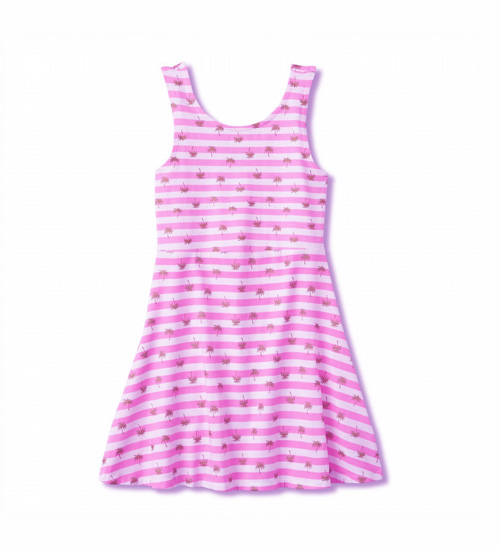
Polos, caps and knitted beanies suit embroidery. A knit has too much texture and stretch for a clean print, which is why a beanie logo is almost always stitched or sewn on as a woven label. Hoodies can go either way, since heavy fleece holds stitching well and a big back print suits a hood. The Luna skater dress, for one, has the Milkshake embroidered onto blue and white striped jersey.
Polyester sportswear is sublimation or transfer territory. A one-off birthday tee for a mate is heat transfer every time. Nobody makes a screen for six shirts.
How to tell what you've already got
Look inside first. Stabiliser on the reverse means embroidery. A clean inside with the design only on the front means print or transfer. Then stretch the fabric gently across the design. Plastisol stretches with the shirt and may show fine crazing on an older tee. A transfer usually shows a sharp outline, sometimes with a faint shiny halo where the glue spread past the artwork.
Knowing which one you've got tells you how to look after it. Prints and transfers want cool water and no iron on the front, and our post on preserving and ironing graphic tees goes into the detail. Embroidery wants a gentle wash and drying flat. Next time you're browsing the shop, zoom in on the photos and see if you can spot which is which.
From the shop
Tees, hoodies, dresses and beanies, most with the Milkshake logo on them.
Browse the range